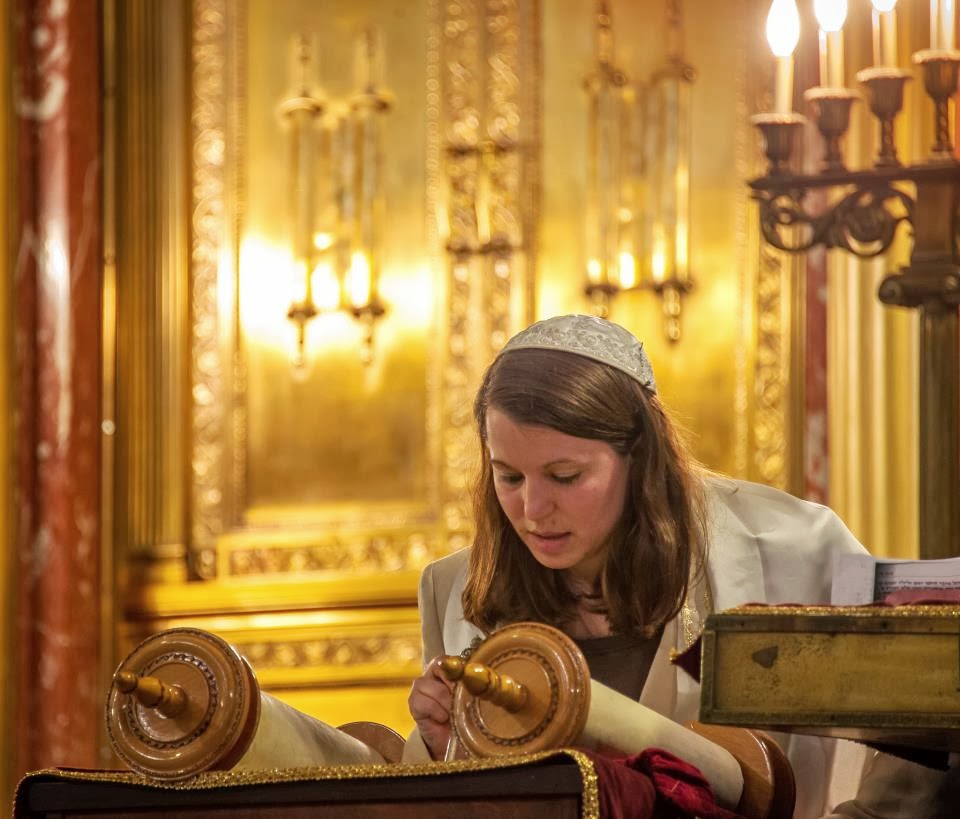
Shabbat Shalom! I have so enjoyed the month of divrei Torah filled with folklore and Harry Potter references, that I wanted to resurrect one on that theme that I wrote for this week’s parasha a few years ago. I’m not with my congregation tonight, so I’m not delivering this anywhere else, but wanted to share it anyway while it still felt relevant, and then next week I will move on from this theme to some other pop culture reference that feels more grounded in the new season.
This week’s Torah portion is Toldot. Jacob and Esau, twins, are born. They struggle with each other in Rebecca's womb, and then after they are born, they struggle with each other in life. Jacob is portrayed as a sweet boy who stays home and helps with the cooking. Esau, on the other hand, gets a pretty bad rep from our ancient rabbis, a reputation which has carried on to today. There are many midrashim and commentaries that claim Esau was a murderer, an arrogant brute of a man, and that he was obviously not worthy of the blessing or birthright of his father. However, the text does not show this. We see an impulsive man, one who seems to be used to having to fend for himself, to take his chances when they arise, who knows that they may be yanked away. The Torah also tells us that Esau is born with a ruddy complexion, which the rabbis interpret as a sign that he has or will have blood on his hands, but that seems a bit of a stretch. The only blood on his hands that we ever see in the Torah is the blood of the animals he hunts, which again the rabbis point to as a sign of some sort of cruelty. But Isaac loves to eat meat, so why shouldn’t his son learn to love and be good at providing it?
When Esau learns that his blessing has been given to his brother, his first thought is not immediately to harm Jacob. He first weeps in anguish, in bitterness, and begs his father to bless him too. Isaac explains the blessing has already been given to Jacob, and Esau cries out, “Have you only one blessing? Bless me too, Father!” But Isaac has nothing left to give him. He is maybe out of line when he does, at the end of this scene, threaten to kill his brother, but he never really makes an attempt to do so. Jacob runs away, and Esau does not run after him, and when they are reunited again in a few parshiyot from now they are both very gracious to each other. Maybe Esau never really meant he was actually going to kill his brother, but meant it more like, “Grrr I’m gonna kill you,” as many people today might say to their loved ones when they’re being obnoxious.
While there are layers of rabbis from ancient to medieval times describing all the sins and evil qualities of Esau, those qualities just aren’t found in the Torah itself. The Torah itself shows us a man, maybe not a man with the best foresight or intuition or not a man who's great a controlling his emotions, but still not an evil man. I see a sad, scared man, betrayed by his own family. Maybe one takeaway from this Torah portion is to not judge a book by its cover, or an argument from one side. Esau is a hairy, reddish colored hunter, and I think often depicted as larger than Jacob, although the Torah doesn’t specify size. You might have been told, as many are, that Esau was a brutish man, villainous from the start. That sounds like a guy any of us would run away from, too, probably.
But I find the similarities between Esau and Rebeus Hagrid, the groundskeeper at Hogwarts School of Witchcraft and Wizardry, to be rather heartwarming. Many Hogwarts students, as well as adults, dislike or are afraid of Hagrid because he is large, hairy, and has a ruddy complexion. He knows his way around the scary and ominous Forbidden Forest, is handy with a weapon, and loves dangerous animals. Rumors fly around about him that indicate what a ferocious beast of half-giant he is, and many keep their distance. In reality, he is a sweet soul, kind of alone in the world, just trying to live his life. We will encounter people like Hagrid and Esau. People who are judged by their outward demeanors, who have rumors of the violence and untrustworthiness spread about them, and from whom many folks stay away because of what others have told them. When we come across these people, let us emulate Harry, Hermione, and Ron, rather than our own ancient rabbis in how we deal with them. Let us be kind, and get to know people for who they really are, not for what they look like or what others may say they really are. And may we be graced with friends as loyal as Hagrid and as in touch with their emotions as Esau, that we may all strengthen each other in community.
Wednesday, November 7, 2018

Saturday, November 3, 2018
Parashat Chayei Sarah post-Pittsburgh
Shabbat Shalom. Our Torah portion this week, Parashat Chayei Sarah, opens with Sarah’s death. We are told the years that her life numbered, and are left to interpret from this the legacy she left in these years. The great medieval French commentator Rabbi Shlomo Yitzhak, or Rashi, assures us that that the repetition of the word “shana,” or “year”, in the opening sentence is to communicate that each year of Sarah’s life was enjoyable and blameless. She was the epitome of a righteous woman, who opened her tent, cared for travellers, and loved her family deeply. We see from the text that she did indeed have her hardships and questionable choices, despite what Rashi would have us believe, but in truth that only makes her that much more human and thus remarkable in her good deeds.
When she dies, Abraham mourns and wails. But then in the very next sentence, the Torah tells us he got up and got to work to do what needed to be done. He not only secured a burial place for her, he purchased the first plot of property in the Holy Land that belonged to a Jew, paving the way for his children and descendants, then he goes on to find a wife for Isaac to ensure that he has descendents to appreciate the property value. He mourns but he does not languish. He does what is right to properly honor her memory and legacy, to fulfill the promise of God that brought them to a foreign land, to care for the family and community still living.
As we celebrate our first Shabbat after the largest antisemitic attack on American soil in history, we must note Abraham’s strength in this moment. We can mourn and wail, but then we get up and do what needs to be done. There are many ways to interpret this, so many ways to ensure the Jewish future and to hold close the community that stands with you in mourning; you must not shrink back in this time of sadness, anger, and fear. Take a moment now to turn to the person next to you or behind you and wish them a Shabbat Shalom. Introduce yourself if you don’t already know the person sitting next to you, maybe hug if you do know each other, and just take a moment to really see the person sitting in Jewish community with you in this sacred moment. *pause*.
Staying in a targeted community after an acute attack can be frightening. Continuing to do the work of ensuring the future of that community without know what the future of our environs might look like is an uncertain endeavor. And for that too, we can gather strength from our ancestors in this week’s parasha. In the next chapter of Parashat Chayei Sarah, the focus shifts from Sarah and Abraham to Isaac and Rebecca. Rebecca is just a girl at the well, who sees a man in need and helps him. She goes above and beyond what is necessary, to allow him to drink, and brings bucket after bucket to ensure that his camels have had their fill as well. We don’t know anything about her life before this moment, her own experiences with grief or fear, but we see her behaving as the pure embodiment of chesed. When the man reveals who he is, and asks her to come back with him to meet Abraham and Isaac, to shoulder the responsibilities of being the next mother to this budding great nation, she agrees immediately. Her family is skeptical, wants to wait things out and get more information about the visitor and the family he wants to bring Rebecca to, but Rebecca’s heart is open to a new experience and ready to live life at full throttle. We in the modern world, especially as women, know that of course we do need to be vigilant of our surroundings and not go off with strange men alone. But in the wake of a tragedy when the impulse for many may be to lock doors and keep out newcomers or visitors, to hide in isolation, we can learn from Rebecca to remember to go out into the world seeking love and joy and adventure. Otherwise, what is the point, really?
There is a story from the Holocaust. A group of Hasidim were being marched to their deaths and a Nazi demanded they sing, a la Babylon. At first, one man started to sing a dirge about walking to their deaths, but no one joined in. So he switched to a lively tune and sang the words, “We will out live them,” in Yiddish. Everyone in the group joined in and they danced in that frantic Hasidic way cheerily chanting their new mantra, until they were shot. They knew they would not literally outlive the Nazis, that they were staring down the barrel of the gun that would in fact end their lives. They were singing that Judaism would outlive hate, and that their lives were so full of ecstatic spirituality, even in the worst moments, that they outlive, in the sense of outdo, these heartless Nazis, that they exceed in the art of living worthwhile lives.
The slogan “We will replace” them became a term of Jewish resistance after that and has been used in various circumstances throughout the last almost 80, including of course this past week. We must be true to the origin story, if we want to use that slogan, and true to the legacy of our ancestors. It is not enough to live, or even to live as Jews. We must love as Jews, love being Jewish. We must embrace all that life has to offer, know when to leave home to go and meet our Beshert. We must know when it is time to cry and when it is time to get up and get things done. We must ensure that the world we pass on to the descendants of Abraham and Sarah, Rebecca and Isaac, the inheritors of this Torah and their legacies, is one of love and has room for happiness and joyous, diverse, thriving Jewish communities. We must build this world from love. And if we build this world from love, then God will build this world with love. And may we see a day when we are all safe in our houses of worship, free of fear, that we may find all communities open-hearted and full of joy. Amen and Shabbat Shalom.
Friday, October 26, 2018
Parashat Vayera - Angels and Demons (not about a Dan Bown novel)
Shabbat
Shalom! I recently started listening to a boatload of new podcasts, and among
them is one called Throwing Sheyd, which is a very clever name because
“Throwing shade” is a slang term for saying something rude to someone in a
subtle way that they can pick up but still gives you plausible deniability
about your intent, and a sheyd is a Hebrew term for something akin to a demon.
There are a few terms that the Hebrew scriptures and the ancient rabbis used to
refer to the harmful spirits in the world - sheidim, se’irim, mazzikim, the
children of Lilith, and more, and they each represent different specific types
of demons or demon-esque beings. Jewish demonology is well fleshed out in early
rabbinic texts, and I’d known some things from rabbinical school, like that the
mazzikim are particularly out in full force on Wednesdays, but I’m learning so
much more from the podcast, like that sheidim have mitzvot!
On the episode I listened to most recently (which was not the most recent episode, because I’m catching up on some old episodes), the hosts talked a bit in particular about the dichotomy of angels and demons. This dichotomy is not quite as direct as one might think from the Christian-influenced popular imagination. Jewish demons are not fallen angels
or anything like that (that’s a different fantastic beast altogether elaborated on in Midrashim for Parashat Noah). Sheidim and their ilk are distinct creatures and not former celestial beings. But they run around mostly unseen causing harm and leading Jews away from God and Torah in basic opposition to the way angels run around mostly unseen doing God’s bidding and enforcing Torah. Although, of course, I’m using run figuratively, because angels in their true form have only one leg, another thing I learned from the podcast. And just
like demons appear vaguely in the Tanakh but are more fleshed out in the rabbinic literature, angels also appear in the Tanakh, sometimes more explicitly than others, but are on the whole more fleshed out in later texts.
Look at this week’s Torah portion, for example. At the top of Parashat Vayera, the Torah tells us that the Lord appeared to Abraham and then Abraham looked up and saw three men approaching. The text uses the word “men” here, but they are generally understood to be angels, two of whom will continue on to Sodom to destroy it and its neighboring city of Gomorrah. Partially this is derived from the fact that the men who visit
Abraham’s tent bring a prophecy of Sarah’s pregnancy and the birth of Isaac, which is not super typical behavior of your average mortal traveler, and partially because when they leave Abraham’s tent, they go on to Sodom, and the next chapter (same parasha) opens with “The two angels arrived in Sodom.”
I always thought that the peshat, the most direct interpretation, of the opening verse indicated that Abraham recognized the divinity of the three men walking up. That what was meant by “The Lord appeared to Abraham, and he looked up and saw three men,” was that the Lord appeared IN those three men. However, the general accepted rabbinic interpretation of this is that God was paying a bikur cholim call, a wellness visit, to Abraham.
The previous parasha ends with Abraham circumcising himself at an advanced age, and the rabbis concluded he’s feeling a bit tender and immobile, so God is chilling with him, keeping him company. I do love that image, and I can appreciate the rabbinical message there about how much more audaciously hospitable Abraham then is when he runs out to greet the three travelers approaching. One, because he is supposedly in physical pain, but he jumps up and moves quickly to welcome in his new guests; and two, because he is ditching God to spend time with who he ostensibly thinks is his fellow man. But what reinforces my view on the peshat understanding is that I can’t understand why the angels would need to approach to bring God’s message and prophecy for Sarah, if God is already kibbitzing with Abraham.
Rashi says that there are three because each angel has a distinct job. One to overthrow Sodom (definitely something to be said for God delegating out this responsibility), one to announce to Sarah the birth of Isaac, and one to cure Abraham (the latter two seem more distinctly superfluous if God was already physically present in their tent). When “The two angels” arrive in Sodom, Rashi reports it is of course because the one who came to inform Sarah was done and went back to the Heavens, while the one who was sent to destroy Sodom and Gomorrah still had a job to do, and the one who healed Abraham was also responsible for rescuing Lot and his family (which checks out - those are similar duties). Rashi also comments that the angels took an awfully long time to arrive at Sodom, considering they are angels and surely could have flown in, perhaps even on unicorns or any number of magically flying animals available as transportation only to them. But they are angels of mercy and were hoping to buy Abraham some time as he argued with God about
whether the deed truly needed be done.
In response to the question of why the Torah sometimes calls them men and sometimes calls them angels, Rashi offers two possibilities. One is that when they are in the presence of the Lord at Abraham’s tent, they are mere men by comparison to the One Most High. The other is that they appeared to Abraham as men, and Abraham truly believed them to be merely men. It was the custom of Abraham to greet all people as warmly as he greets the angels, to see the holiness in any traveler, and so it became the custom of angels to go hang out with Abraham for this reason. However, when they appeared to Lot, it was necessary to appear as angels, so that the less pious nephew would regard them properly and leave Sodom with them. In either case, neither the Torah nor Rashi describe the appearance of the angels, and the descriptions we see later in some of the prophets, and as our adult ed students know, in the book of Daniel, the angels are able to take on human
forms, but still never fully pass as human. I mean, besides the one-foot thing. Daniel always knows when he’s being spoken to by an other-worldly being.
I’m unsure where the tradition lands on this, but something that occured to me as I read this parasha and listened to Throwing Sheyd, is that if angels can appear as men and be welcomed into one’s tent, then probably, so could demons. Depending on the type of demon, this could be a bad omen - welcoming in disaster, opening the door to pain, and we
could read it in very real terms of one not asserting necessary boundaries and allowing themselves to be harmed by the evil in the world. But perhaps it could be a good thing too. As I said, sheydim must adhere to some mitzvot, and perhaps they are not all inherently evil. What if Abraham, or you or me, opened the door for a mischievous imp-like creature and showed them the power of welcoming and warmth? Would they turn from their trickster ways and seek to do more good in the world? I’m not sure it’s always so easy to tell which type of otherworldly creature we are opening our doors to, but if we were able to read
each person, or person-like being, that we meet and try to learn about and from them with an open heart, I think we might find ourselves better able to model the audacious hospitality of our father Abraham, and make this world a little better for everyone. May you open your hearts and doors, and may you in turn be blessed with good news and safety. Amen and Shabbat Shalom.
Friday, October 19, 2018
Parashat Lech Lecha and Dybbuks
Shabbat Shalom! This week’s focus of fantastic beings is dybbuks. Dybbuks are
sometimes confused with demons or generic ghosts, but they are something in
between. The word dybbuk comes from the Hebrew verb “davek” – to cleave or to
cling. Among the demonology and stories of various types of spirits roaming the
world found throughout the Talmud and Kabbalistic literature, there are stories
of human souls who cling to this world when their body dies and who cleave to
the soul of a living body. In the folklore of European Jews from the 17th century on, the phenomenon of a person’s possession by a clinging
soul came to be blamed on the being known simply as a dybbuk, and was generally
considered a bad thing.
Having grown up in a haunted house, I know that not all clinging spirits are
malicious. True, my grandmother’s ghost did not try to possess anyone as
dybbuks are known to do, but she did once appear in a fiery image outside the
window overlooking the backyard to tell my cousin’s boyfriend to get out of her
house. My cousin broke up with the guy shortly thereafter. For context, Grandma
Irene wasn’t being a dramatic dybbuk with the fire thing; she did actually die
in a fire in the backyard. For about one week straight in January 1998, our TV
kept turning itself on for 6:00 news, though no one in the family remembered
setting the timer. That would be about when we were sitting down for dinner,
and no one wanted the TV on then. My parents made a few attempts to ensure
there was no timer set or to turn it off. The last time the TV turned itself
on, the news was reporting a large fire in our town. It had started in a
beloved family-owned bakery downtown and ended up damaging several Main Street
businesses. Thankfully, no one was hurt, but it seemed Grandma Irene wanted us
to keep up on fire-related news in town. There were other, more mundane signs
that maybe on their own wouldn’t be so obvious, but coupled with the distinct
fire-related hauntings led us to still imagine them as acts of Grandma Irene’s
soul clinging to the house in which she had raised her children, lived for many
years, and where she had died, and where her youngest daughter was now raising
her own children. For years, three different family dogs, owned separately,
would sit down at the foot of the stairs and stare up expectantly around the
time Irene would be getting ready to go to work if she were alive. A few years
ago, my dad was home alone and doing some housework. He swears he very
distinctly felt a tap on his shoulder. He jumped a foot in the air, turned off
the vacuum, and looked around, but there was no one there. The house was quiet,
and there have been no more spooky happenings since then. We think Irene was
saying thanks to her son-in-law for keeping up her house and taking care of her
family, and saying goodbye. My sibling and I had already moved out of the house
and were more or less grown, and she didn’t need to look after us anymore. We
wondered if she went to Phoenix to keep tabs on her great grandchildren, but we
haven’t heard any stories from my cousins out there. We assume and hope that
her soul finally let go of its grip on this world, and returned to its maker.
Hopefully, Irene is no longer a dybbuk.
The stories of the Talmud and Kabbalah claim that dybbuks can be created by
malicious souls that linger in this world because they are so sinful they do
not want to return to the Creator, or they can be created by pure souls that
are wronged somehow and they cleave to the one who wronged them. Maybe some
stick around out of love, an unwillingness to leave their families, a desire to
stick to the souls that they felt connected to in life.
In this week’s Torah portion, Parashat Lech L’cha, we are told that Abram and
Sarai leave Haran with a caravan, taking with them to the Promised Land their
nephew Lot and his family, and “all the souls they made”, as well as all their
“possessions”. The most common Midrashic explanation of this line is that they
converted all their servants to monotheism and made their souls as if new with
the love of God. But we know that Abram and Sarai are known and will later be
blessed for their hospitality. In my experience, being proselytized to is not
very welcoming, no matter how friendly the person seems when they’re trying to
“save your soul.” What if, rather than converting servants and hauling them
along this journey that’s really not for them, Abram and Sarai were actually so
open and welcoming that the people who dwelled among them clung to their souls
like a dybbuk. I’m not necessarily saying that all the “souls” Abram and Sarai
brought to the Holy Land were ghosts, but I’m also not saying that none of them
were. Either way, what I’m really saying, is that love is a very effective glue
to stick one soul to another. I’ve never been haunted by a dybbuk that cleaved
to this world out of malice or hurt, but I spent all my childhood with one that
clung on in love. As a living person, I know anger can feel haunting, but it
generally passes and does not consume the soul, yet unconditional love lasts
and connects two souls forever. I hope I’m not inviting in a host of ghosts to
the synagogue by saying this, but how beautiful would it be to create a
community so open and welcoming, so filled with unconditional love for each other,
that our souls clung to one another, cleaved to Ner Shalom, and stuck around to
help make this synagogue the best it could be for as long as we could. May your
homes be ghost-free, but your lives filled with love and souls that cling to
yours in joy. Amen and Shabbat Shalom.
Thursday, October 11, 2018
Parashat Noah and Keeping Kosher without Defined Kashrut
Shabbat Shalom! In this week’s Torah portion of Parashat Noach, God tells Noah to take pairs of all the animals on Earth onto the ark, male and female, so that the species will not go extinct as the Earth is destroyed. First, God says to take two of everything, but in the next chapter (Genesis 7) as more details unfold, God says to take 7 pairs of every clean animal, and one pair of every not-clean animal.
What does clean and not-clean mean? The Hebrew used is not the same as would be used for, say, clean and dirty laundry (naki). It uses the word “tehora” for ritual purity, meaning the “clean” animals in this case are ones suitable for sacrifices to God or are considered Kosher. And yet, at this point in the Torah, Kosher laws have not yet been given, only one animal sacrifice has been made, and it’s unclear how Noah would know what was clean or not-clean. It also seems worth noting that the Torah literally says “tehora” and “lo tehora” or “ein tehora”, meaing “pure” and “not pure” or “without purity”, rather than using the typical opposite term of “tamei”. So although these verses imply some sense of what would be considered pure in the mitzvot ahead, they also imply that perhaps the full scope of what it meant to be pure/impure was not yet known.
It is generally believed that the first humans did not eat meat, and were only officially allowed to eat meat after the flood. Some midrashim even point to cruel methods of animal-eating as some examples of the violence of the generation of the flood. Commenting on Parashat Bereshit, the Talmud says, “The First Earthling was not permitted meat for eating, as it is written, ‘...to you it will be for the eating. And to all the animals of the earth…’ and not [written] ‘the animals of the earth for you.’ And when the children of Noah came [out of the ark] it was permitted for them [to eat meat], as it is said, "as the green herb I have given for you all" (Sanhedrin 59b:13-14).” The 13th century Rabbi David Kimchi from Provence even went so far as to suggest that in the beginning, all animals ate only plants, even those which we would recognize today as predator animals. But after the Flood, God says to Noah, “Every creature that lives shall be yours to eat.”
This verse says “every creature,” and leaves out the concept of “tehora,” again drawing confusion about what the Torah means in chapter 7 and how Noah understands that. I will say on this matter, that I grew up eating “every creature,” or at least all the ones Americans generally eat, including treyf. I became a vegetarian at 12 and started eating meat again while in Israel at 20. Transitioning to keeping Kosher was not only easier in the sense that coming from vegetarianism, I was adding things back into my diet rather than restricting them, but it was also spiritually easier than diving fully back into eating anything. It made sense to only add certain dishes, and to keep kosher as a way of continuing to practice mindfulness over my animal consumption after years of refusing to eat them at all. It is not clear that this was the case for Noah, but I offer this anecdote as perhaps a look into Noah’s kashrut, despite the apparent reality that the laws of Kashrut were given many generations later.
At the beginning of this year (as in January, not as in Tishrei), a friend and fellow rabbi responded to a tweet asking if porgs (the vaguely penguin-esque creatures from Star Wars Episode VIII) were kosher. This led down a jackalope hole of what other fantastic beasts may or may not be Kosher. While looking further into that topic for our Fantastic Jewish Beasts and Where in the Text to Find Them event, I also purchased a book called “The Kosher Guide to Imaginary Animals.” It’s not unlike the original book of Fantastic Beasts and Where to Find Them, in that it is extremely short and reads basically like a short field guide to imaginary creatures, but then with the added element of determining whether or not Jews could or should eat them. For the most part, the answer is no. Don’t eat Fantastic Beasts. We’ll talk more about which ones and why on October 28th, but that seemed to be the answer for the majority of the creatures in the guidebook and in the Twitter thread, including the imaginary animals discussed a whole sideline conversation about what would be Kosher for Jewish dragons specifically. Several of the contributing writers to the guidebook, and the comments coming from the other rabbis jumping into the Twitter thread suggested that this type of conversation is not new or unusual. As long as humans have been eating meat, and as long as these myths and folklore have existed, people have pondered what could be on the menu, whether it is Kosher, how it could be caught and slaughtered, what it would taste like, how it should be served. It seems that if these are the conversations humanity seems to have been having for the last thousand years or so, then it’s not so far fetched that 3000 years ago, before Kashrut existed as such, humans were still in some fashion wondering, “Is this ok to eat? How can I eat it? Is it capture-able and able to be domesticated? Is it pure? Will it make me sick, physically or spiritually?” And if they determined that it was edible, could be domesticated, could be killed in a humane way and served in a manner than separated it’s intelligent predator from the knowledge that this too was once alive, then it was “clean”, or “tehora”, even if more specific identifiers for the pure and impure status had not yet been recorded.
This Shabbat, we bless all our animals. The ones we have loved as companions, and the ones that have nourished us. The ones that we have seen in zoos, and the ones we have only seen in our imaginations. Some animal-lovers prefer to stick to the vegetarian lifestyle, while others recognize distinctions between different sorts of animals. However you love your animals, however your diet, may you take the time this Shabbat to appreciate all the ways in which the animal kingdom, real and imagined, has served humanity, and may we give thanks to the Creator of all who has made a world with such diversity in creatures. Amen and Shabbat Shalom.
Subscribe to:
Posts (Atom)